
How Much Does Fence Line Clearing Cost in South Carolina?
Published cost guides put forestry mulching at $125 to $300 an hour or $400 to $800 an acre. A skid steer mulcher runs $1,000 to $1,600 a day. A fence line is a narrow strip, so 1,000 feet cleared 12 feet wide is about 0.28 acre. Minimum fees of $250 to $600 a visit can set the price.
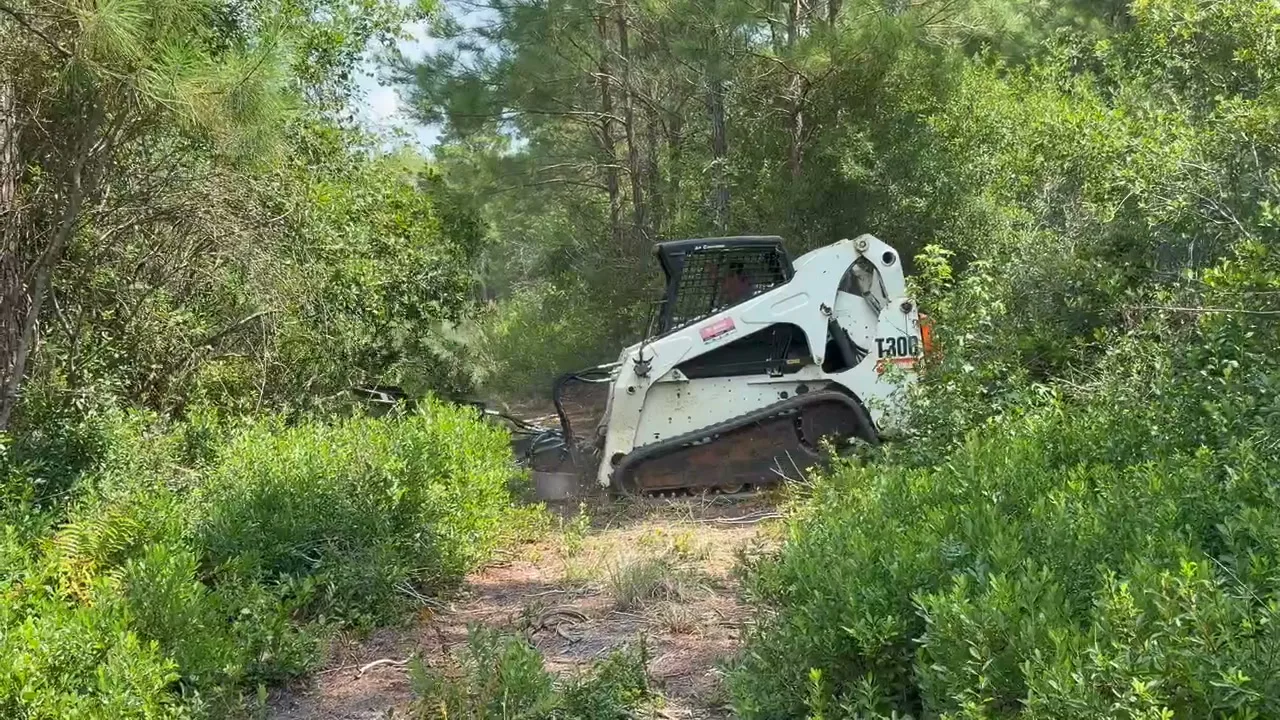
Fence line clearing takes the growth off a strip along the wire and leaves the fence standing. In Horry County that growth might be greenbrier, wax myrtle or a row of pine seedlings. Our Bobcat T300 carries a forestry mulcher head for clearing an overgrown fence row or access lane. It grinds that growth where it stands, and the chips stay on the ground as cover.
Every figure below is a market range from national cost guides, not a quote from us. Our own estimates are free and done on site.
How do contractors price fence line clearing?
Published guides price mulching work by the hour, by the day or by the acre. Most jobs also carry a minimum or a trip charge. The table pulls those ranges into one place.
| How the work is priced | Published range | What the guide says |
|---|---|---|
| Per hour, underbrush to small trees | $125 to $200 | Includes the machine and the person running it |
| Per hour, heavy brush and large mature trees | $300 to $400 | Top of the same hourly table |
| Per day, skid steer mulcher | $1,000 to $1,600 | For underbrush to small trees |
| Per acre, forestry mulching | $400 to $800 | Up to $2,000 on dense ground |
| Per acre, brush with no major trees | $330 to $630 | Brush only |
| Per acre, light brush | $800 to $1,800 | No trees or a few young trees |
| Minimum per visit | $250 to $600 | Brush clearing minimum fee |
| Mobilization fee | $150 to $300 | Setup, charged by some companies |
Hourly pricing bills the time the machine runs on your line. A day rate books the machine for the whole day. Per acre pricing measures the strip itself, which makes it the easiest number to check.
One guide says a skid steer mulcher covers 1 to 3 acres a day. A 0.45 acre strip is 15 to 45 percent of that, before careful passes near the wire. These are national figures, so treat each one as a starting range.
How many acres is a fence line?
Per acre pricing works on a strip once you know its area. Multiply the length of the line by the width you want cleared. Then divide by 43,560, the number of square feet in one acre.
A strip 10 feet wide has to run 4,356 feet to make one acre. That is about 0.8 of a mile. Shorter lines come out as a fraction of an acre, as the table shows.
| Fence line | Cleared width | Square feet | Acres |
|---|---|---|---|
| 1,000 feet, one side of the wire | 12 feet | 12,000 | 0.28 |
| 1,000 feet, both sides of the wire | 12 feet each side | 24,000 | 0.55 |
| Quarter mile, 1,320 feet | 15 feet | 19,800 | 0.45 |
| 4,356 feet, about 0.8 mile | 10 feet | 43,560 | 1.00 |
Clearing both sides of the wire doubles the strip. So does doubling the width on one side. Ask each bid for the length and width it assumed, so two quotes measure the same ground. For whole blocks of brush instead of a strip, see what forestry mulching runs by the acre in South Carolina.
What does a typical fence line cost to clear?
These worked examples run the published ranges through the strip math. They are estimates from published ranges, not a price from us. Your line’s growth, ground and access set the real number.
Take a 1,000 foot line cleared 12 feet wide on one side, about 0.28 acre. At $400 to $800 an acre, the mulching math comes to about $110 to $220. Dense ground at up to $2,000 an acre brings it near $550.
That short line runs into the minimum. Published minimum fees of $250 to $600 a visit sit above most of that math. One national calculator also carries a three hour minimum labor charge. At the hourly range for underbrush and small trees, three hours comes to $375 to $600.
A longer line shows how growth moves the total. Here is a quarter mile line cleared 15 feet wide, about 0.45 acre, run through four published per acre ranges.
| Growth on the quarter mile strip | Published range per acre | Estimate for 0.45 acre |
|---|---|---|
| Brush with no major trees | $330 to $630 | About $150 to $290 |
| Forestry mulching, typical ground | $400 to $800 | About $180 to $360 |
| Heavy brush, half brush and half trees | $1,600 to $3,000 | About $730 to $1,360 |
| Forestry mulching, dense ground | Up to $2,000 | Up to about $910 |
Clearing both sides of the 1,000 foot line doubles the strip to about 0.55 acre. That puts the mulching math near $220 to $440, or up to about $1,100 on dense ground. For a full day, one guide lists $1,000 to $1,600 for a skid steer mulcher.
What makes one fence line cost more than another?
Width and sides come first. Every added foot of width adds area along the whole run. A bid for both sides of the wire covers twice the ground of a bid for one side.
Growth type sets the hourly tier. One guide prices underbrush to small trees at $125 to $200 an hour. Heavy brush and large mature trees run $300 to $400. The same guide notes that heavy overgrowth takes longer to mulch than light brush. Our mulcher head takes stems up to roughly 6 to 8 inches across.
Old wire and posts buried in the brush slow the work. The mulcher head has to stay clear of them. Point out loose wire, old posts and corner pins before work starts. Finer mulch also costs time, since one guide notes it takes more passes over the same ground.
Soft ground after rain moves the number too. One guide warns that wet seasons raise equipment costs when machines get stuck in mud. Another notes that softer soils call for different equipment. Our T300’s rubber tracks spread its weight on soft coastal ground. Standing water waits for a dry stretch.
Gates and travel finish the list. One guide lists extra fees when a fence has to come down to let equipment in. A gate the machine fits through avoids that. Guides also note transportation fees based on a company’s service area. We work about 50 miles around Longs, SC.
Which plants close a fence line in coastal South Carolina?
NC State Extension plant profiles describe the vines, shrubs and seedlings that fill a fence row.
Greenbrier is a thorny vine found in hedgerows and thickets. It climbs or sprawls up to 20 feet and spreads by rhizomes. Its thorns run up to a third of an inch long.
Wax myrtle tends to sucker and can form sizable colonies. It tolerates salt spray and grows in seaside areas, which fits the Grand Strand.
Chinese privet came to this country in 1852 as an ornamental. It has turned invasive across the eastern and southern states. It grows 6 to 15 feet tall and spreads by suckers into thickets. Birds and mammals eat its fruit and spread the seeds.
Japanese honeysuckle is classified as highly invasive by NC State’s weed specialist. It spreads by rhizomes and by runners above ground. It can grow over other plants and smother them.
Trumpet vine climbs by aerial rootlets. It suckers from underground runners and can form colonies that choke out other plants.
Poison ivy grows in fence rows, among other places, and its vines climb fences. Sweetgum carries a rapid growth rate, and loblolly pine has the most rapid growth rate of all pines. Loblolly also spreads into old fields by self-seeding.
Vines woven into the wire and thorny thickets take more passes. Seedlings left in the line keep growing, which pushes a job from the underbrush tier toward the tree tier. Privet or honeysuckle that has spread into the lot calls for removing invasive thickets past the fence row.
Why does mulching in place skip the burn pile?
A burn pile adds rules and labor. South Carolina law requires notice to the SC Forestry Commission before burning outdoors. That rule covers unincorporated areas, outside city and town limits.
Horry County sets rules for burning when clearing land. A fire must sit at least 50 feet from any structure and from any other property line. Brush cut from a boundary fence starts on the property line. Every armload would have to move at least 50 feet in to burn.
The fire also has to sit 1,000 feet from public roads and from homes or businesses off the property. During a county burning ban, no open burning is allowed.
Fence rows also hold poison ivy. NC State Extension warns against burning it, since contact with the smoke can be as toxic as touching the plant. Breathing that smoke can be even more hazardous. The same profiles rate greenbrier, trumpet vine and loblolly pine high for flammability. Wax myrtle’s leaves, stems and branches hold flammable aromatic compounds.
Mulching in place skips the pile. The chips stay on the strip as ground cover, and nothing is burned or hauled. It also skips cleanup costs. One guide puts cleanup labor at $50 to $80 an hour and hauling at $150 to $200 a pickup load.
What does a fence line clearing price not cover?
The price covers the growth on the strip and stops there. Fence building and fence repair are outside the job, and so is pulling old posts. Stumps stay in the ground rather than getting dug out. Nothing gets hauled off, burned or sprayed.
That scope matters when you compare bids. One guide notes many land clearing services include debris removal in their quotes, but others charge separately. Ask for an itemized bid so each quote covers the same work.
A clean strip also sets up the next step. A fence crew can set posts and run wire along a line they can see.
How do you keep the next fence line bill low?
Clear the line before saplings take over. The hourly table shows why. Saplings that grow into trees move a job from the $125 to $200 tier toward $300 to $400.
Fence row plants come back. NC State Extension calls Chinese privet very difficult to eradicate once it is established. Honeysuckle and trumpet vine spread from underground runners, and wax myrtle suckers.
Keep the field side open too. Bush hogging the field side now and then helps keep the edge from creeping back toward the wire. When brush has taken the whole field, reclaiming the pasture behind the fence is a bigger job.
How do you get an accurate quote for fence line clearing?
Start with the length. A survey map or a plat gives a number a bid can use. Then decide the width, and whether you want one side or both sides of the wire cleared.
Flag the corners and any survey pins you want kept. Point out gates, soft spots and old wire hidden in the brush. We give free on-site estimates across Horry and Georgetown counties in SC and Brunswick and Columbus counties in NC.