Forestry Mulching vs. Traditional Land Clearing: Which Does Your Property Need?
Forestry mulching fits overgrown land where you want the brush gone and the ground left intact. Traditional clearing fits jobs where stumps must come out and the dirt gets reshaped, like a house pad. Most property owners around Longs and Conway are after the first one.
| Factor | Forestry mulching | Traditional clearing |
|---|---|---|
| Debris | Ground into mulch and left on site. No burn pile, no dump trips. | Wood gets piled up, then burned on site or trucked off. |
| Ground impact | One tracked machine works across the surface. Topsoil stays put. | Dozers and excavators dig in and churn the dirt. |
| Stumps | Cut to grade or a bit below. Roots stay in the ground. | Pulled out root ball and all, so holes get backfilled. |
| Erosion | Mulch blanket softens rain and holds the surface together. | Bare dirt sits exposed until seed or cover goes down. |
| Cost drivers | How thick the growth is and how big the stems are. Heavy timber slows it down. | Machine time, plus stump work, plus burning or hauling. More steps, more equipment. |
| Best for | Overgrown lots, trails, old pasture, fence lines, thinning under mature trees. | Building pads, ponds, driveways, road cuts, large timber. |
What does forestry mulching actually do?
A mulching head is a steel drum with teeth that spins fast. It cuts standing brush and small trees, then grinds that material into chips. The chips drop right where the machine works. There is no second crew and no dump truck.
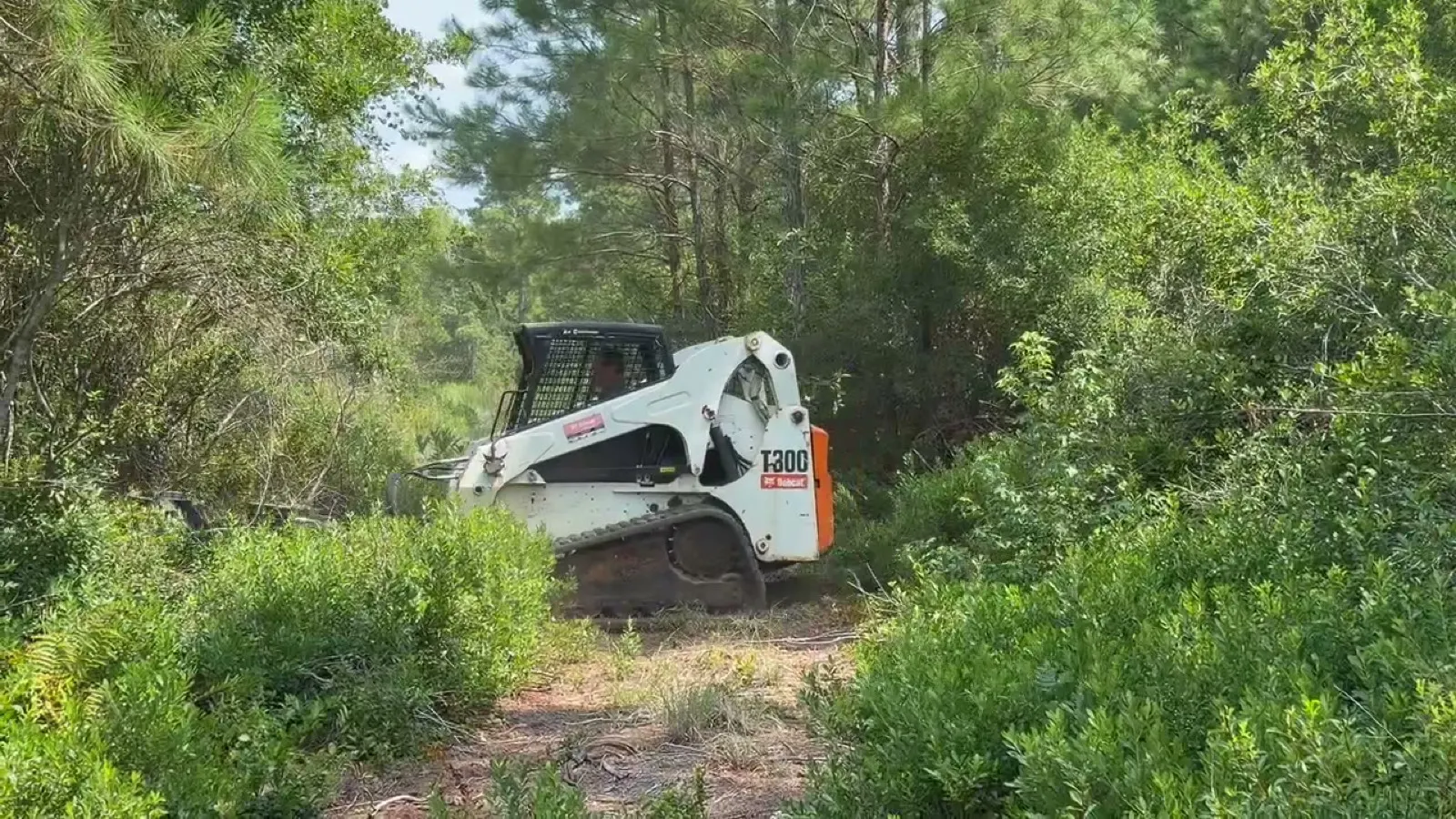
Our setup is a Bobcat T300 compact track loader with a mulcher head on the front. It handles brush and trees up to roughly 6 to 8 inches across. Past that size, the work slows way down.
What you get back is open ground under a layer of wood chips. That layer often runs 2 to 6 inches deep, based on how heavy the growth was. It behaves like ground cover from day one.
What does traditional land clearing actually do?
Traditional clearing is a dig job. A dozer pushes trees over and an excavator pulls the stumps with the roots attached. The wood goes into piles.
Then the piles have to leave. That means burning on site with a permit, or trucking the material away. Both add days and cost.
The result is bare dirt with holes where the stumps were. That is what you want before concrete or a foundation. It is not what you want if the brush was the only problem.
We do not run dozers or excavators. Stump grinding, tree removal, grading, and dirt work all sit outside what we do.
When is forestry mulching the right call?
Mulching makes sense when the soil under the mess is fine and the mess is the problem. Common ones around here:
- A wooded lot you want to see through and cross on foot
- Fence lines and property lines swallowed by vines and scrub
- Old pasture that grew up in sweetgum and briars
- Trails and shooting lanes through timber you plan to keep
- Overgrowth around a house, a pond bank, a shed, or a driveway
Mulching also lets you keep the trees you like. The machine works between mature pines and takes out what grew up under them. A dozer cannot do that.
That is the side of the work we handle. Our forestry mulching and brush clearing services both run off the same machine.
When does a job need traditional clearing?
Some jobs need the other kind of equipment. We will say so up front when yours does:
- Trees bigger than about 8 inches across, or standing timber worth selling
- Any pad for a house, shop, or slab, where roots have to come out
- Ponds, ditches, driveways, or anything that needs dirt moved and graded
- Ground where the stumps must be gone, not cut flat
Stumps left in place rot slowly over years. Under a slab, that becomes a settling problem. Under a pasture or a food plot, it does not matter.
When your job is that kind, we point you toward a company that does it. There is no reason to run a mulcher on work it cannot finish.
What does coastal South Carolina ground change about the choice?
Horry County sits on the coastal plain. Most soils here are sand or loamy sand. The land is flat, and the water table sits close to the surface.
Heavy rain does not run off fast. It sits on the ground.
Bare sand moves. Once a dozer strips a lot, a hard summer storm pushes loose soil into ditches and low spots. A mulch layer takes the hit from the raindrops and slows that down.
Wet ground and heavy machines fight each other. A tracked loader spreads its weight over more surface than a wheeled machine, so it presses in less. On soft winter ground we may still wait a few days for things to dry.
Growth comes back fast in this climate. The season is long, and mulching leaves live roots in the soil. On a thick lot, vines and hardwood sprouts push back through in a year or two. Most owners keep it down with a follow-up pass or a mower.
How do you decide?
Start with what happens on that ground after we leave. That answer picks the method for you.
Pouring a footing or a slab? You need the traditional kind, with the stumps out. Using the land as it sits, for a yard, a pasture, a trail, or hunting? Mulching gets you there in one visit.
Not sure yet? Tell us how big the area is and how thick the biggest stems look. Add what you plan to do with the land. That is usually enough to say which way to go before anyone drives out.
We work about 50 miles on both sides of the state line. That covers Myrtle Beach, Conway, Loris, Little River, Calabash, Shallotte, and Leland. For land clearing in Longs, SC or anywhere in that range, estimates are free. Call (843) 385-1090.