Do You Need a Permit to Clear Land in South Carolina?
South Carolina has no single land clearing permit. The answer turns on how much soil gets disturbed. It also turns on protected trees, wetlands, the marsh edge and burning. Your county or town sets the last layer. Mulching brush in place moves no soil, which clears most of those triggers.
Here is who regulates what.
| Activity | Who regulates it | Permit trigger | What to do |
|---|---|---|---|
| Grading or moving soil | SCDES stormwater program | 1 acre disturbed, a larger common plan, or a coastal half mile zone | File a Notice of Intent and a plan |
| Altering tidelands or the beach and dune system | SCDES Bureau of Coastal Management | Any alteration of a critical area | Get critical area authorization first |
| Mechanized clearing in a wetland | Army Corps of Engineers, Charleston District | Redeposit of soil that degrades a water of the United States | Get a delineation, then ask the Corps |
| Burning outside city limits | SC Forestry Commission | Every debris, prescribed and land clearing burn | Notify the Commission, check for a burn ban |
| Specimen live oak, Horry County | Horry County Planning and Zoning | Live oak at 24 inches DBH or greater | Apply for a Zoning Board variance |
| Protected tree, Myrtle Beach | City of Myrtle Beach | 4 inches DBH for five species, 5 inches for most others | Apply for a tree permit and a clearing permit |
| Protected tree, Waccamaw Neck | Georgetown County Planning | Most trees at 10 inches DBH or more | Apply for a tree removal permit |
| Over an acre in North Carolina | NC DEQ Land Quality Section | More than 1 acre on a tract | File an erosion control plan 30 days ahead |
What triggers a state land disturbance permit in South Carolina?
The state permit follows soil, not plants. SCDES requires stormwater coverage when construction disturbs one acre or more. Smaller sites count when they sit inside a larger common plan of development or sale. In the coastal zone, sites within half a mile of a receiving water are covered too.
The activities SCDES names are clearing, grading, excavating and filling of low areas. State law defines a land disturbing activity as any use of land that changes the natural cover or topography. The change has to be one that may cause erosion, which points at dirt work.
Sites of one to two acres file a simplified plan under Regulation 72-300. Above two acres, a South Carolina engineer or surveyor prepares the full plan. Nothing gets disturbed until the permit letter arrives. State law exempts farm land, forest land worked for timber, and one home built on its own lot outside a subdivision build-out.
Counties set thresholds on top. Horry County keys its stormwater permit to a smaller disturbed area. See the Horry County lot rules in detail for how that lands on a residential parcel.
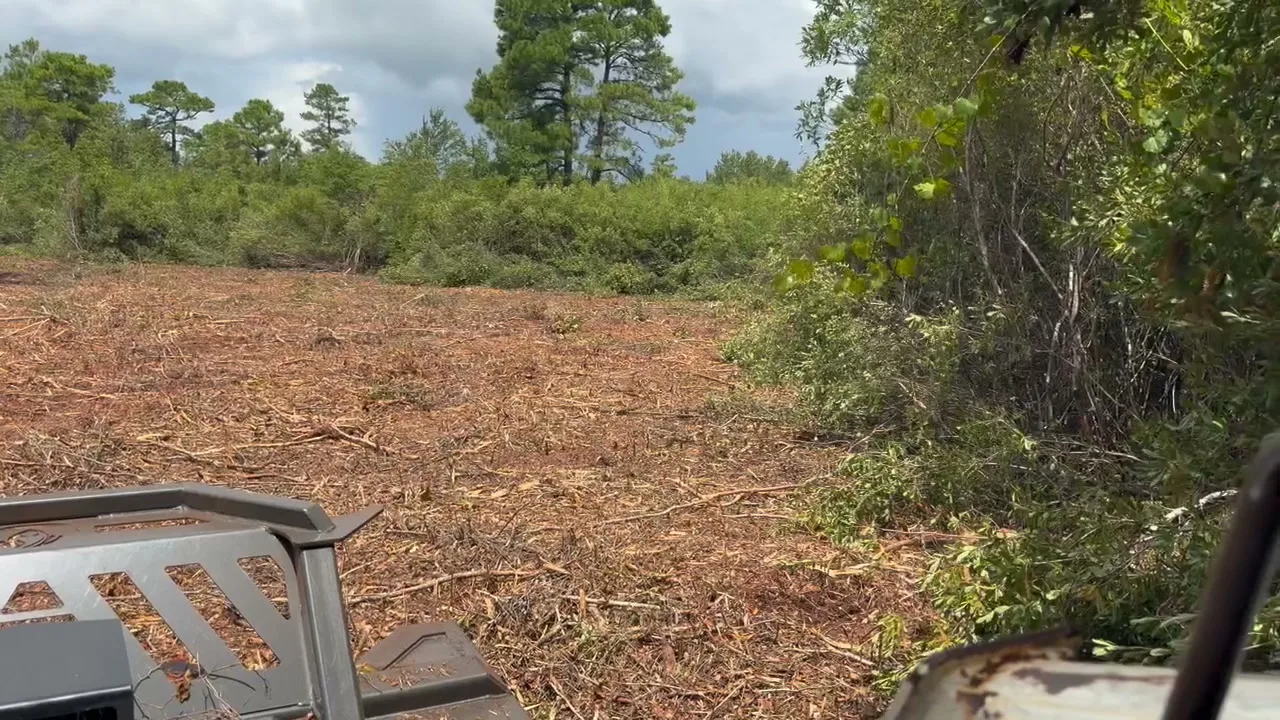
Our land clearing work sits on the plant side of that line. How a mulcher grinds standing growth in place leaves the soil and the root mat alone. No dirt moves, so most land disturbance triggers stay shut. The county still makes that call.
Do the coastal rules change the answer near the water?
They add a layer. Georgetown and Horry are two of South Carolina’s eight coastal counties. A project in one of them needs a coastal zone consistency determination from SCDES. That step comes before the stormwater permit is issued, not after.
By law the critical areas are the coastal waters, the tidelands, the beaches and the beach and dune system. Altering one takes authorization from the SCDES Bureau of Coastal Management. That agency also states its permit does not release you from other permits.
A marsh edge lot can be two jobs in one. The upland part is ordinary land clearing, and what our land clearing work covers stops at the critical area line. Past that line, SCDES decides.
Can you clear a wetland without a federal permit?
Usually not with a machine. Federal rule treats mechanized land clearing in a wetland as a discharge of dredged material whenever soil gets redeposited. The Corps of Engineers regulates that under Section 404 of the Clean Water Act. The person planning the work carries the burden of proof.
The regulation covers any redeposit of soil incidental to mechanized landclearing, ditching, channelization or other excavation. It carves out work that only cuts or removes vegetation above the ground, such as mowing or chainsawing. That carve out holds only where the root system is not substantially disturbed and nothing redeposits soil.
If your ground holds standing water, order a wetland delineation before any machine runs. Start with the Charleston District of the Corps of Engineers. How to find out whether your lot has wetlands, and what you can still do with it walks through the maps, the delineation and the Carolina bays. Horry County’s zoning ordinance also keeps a natural undisturbed 15 foot buffer around remaining wetlands on non-residential and major residential projects.
Do you need a permit to burn what gets cleared?
South Carolina issues no burn permit. State law requires notice to the South Carolina Forestry Commission before you burn. That covers debris burns, prescribed burns and land clearing burns outside city and town limits. Local ordinances stack on top, and a burn ban stops everything.
Notify online at scfc.gov/notify or by the toll free line for your county. In Horry County that line is 1-800-986-5404. The Commission sets conditions too. Burn vegetative material only, clear a firebreak and stay with the fire.
Horry County adds its own rules in Chapter 20 of the county code. The fire must sit at least 50 feet from any structure and any property line. A land clearing burn carries more: 1,000 feet from public roads and off property buildings, and a 9 a.m. to 3 p.m. start window.
Mulching takes the question off the table. The growth gets ground into chips where it falls, so no burn pile forms. That is also how grinding downed limbs and blowdown on site works after a storm.
Which towns and counties protect trees on the Grand Strand?
Each one draws its own line. Horry County protects specimen live oaks countywide. The City of Myrtle Beach permits protected and landmark trees, plus site clearing itself. Georgetown County runs two overlays, and the Waccamaw Neck one is the tighter of the two.
Horry County sets its rule in Section 505 of the zoning ordinance. Removing a specimen live oak is unlawful without a variance from the Zoning Board of Appeals. Specimen means 24 inches DBH or greater. Those live oak standards reach any property in the county, including ordinary house lots.
Inside the City of Myrtle Beach the list is different. Live oak, white oak, eastern red cedar, southern magnolia and bald cypress are significant trees. The cutoff for those five is 4 inches DBH, and most other species are protected at 5 inches. The city also requires a clearing and grubbing permit before site clearing other than mowing. That is why the work we do inside the Myrtle Beach city limits starts with a call to the city.
Georgetown County splits the county in two. On the Waccamaw Neck, every tree of at least 10 inches DBH is protected. The exceptions are palmetto, Bradford pear, pecan, sweet gum, crepe myrtle, wax myrtle and pines other than longleaf. In the rural half, a shorter species list is protected at 12 inches. An occupied house lot there is exempt. The same parcel on the Neck still needs a permit.
Conway runs its own permit. A live oak over 24 inches in diameter needs one before removal.
Thresholds are what matter. Vines, briars and small saplings usually sit below them, though Myrtle Beach starts at 5 inches. What a lot clearing job includes is that understory layer, with protected trees left standing.
Do HOA covenants matter more than county rules?
On a subdivision lot they often do. Covenants are recorded, run with the deed and bind the property owner. South Carolina governs associations under the Homeowners Association Act at Section 27-30-110 and following. Many communities also run an architectural review committee for exterior changes.
Read the covenants before you schedule. Some set buffers along lot lines or restrict tree removal. Ask in writing and keep the reply.
Is the answer different across the line in North Carolina?
Yes, in two ways. North Carolina requires an erosion and sediment control plan for any land disturbing activity over one acre. It also requires an open burning permit from the NC Forest Service, and that permit is free. South Carolina has no such permit.
The plan requirement comes from the Sedimentation Pollution Control Act of 1973. File it at least 30 days ahead with the NC DEQ Land Quality Section or a delegated local program. Approval has to come through before work begins. Agriculture, timber production under the Forest Practice Guidelines, and mining are exempt.
Burning is where the two states really part. Between midnight and 4 p.m., a permit is required for any fire in woodland under NC Forest Service protection. The rule reaches 500 feet past that woodland too. A land clearing burn over five acres needs a special permit.
Brunswick and Columbus counties can add rules on top. Check with the county before you plan a burn or a clearing job there.
What should you check before the machine shows up?
Start before anyone schedules a machine. Pull the parcel, read the ground, measure the big trees, then read whatever came with the deed. Most of it is one afternoon of phone calls. Six items cover almost every parcel on this coast.
- Pull the parcel lines and acreage from county parcel data.
- Decide whether any soil will move. If none does, the stormwater trigger usually stays shut.
- Look for standing water or soft ground. Order a wetland delineation before a machine runs.
- Measure the big trees 4.5 feet up and note the species, then call the zoning office.
- Read the covenants if the lot sits in a subdivision, and ask the association in writing.
- Skip the burn question by grinding the growth in place.
Cost is a separate question, and it moves on density more than acreage. Published national cost guides put land clearing near $810 to $5,870 per acre, with a reported average around $2,900. The published cost ranges by growth density breaks the South Carolina figures out further.
Category 5 Land Management runs a Bobcat T300 with a forestry mulcher head. We work Horry and Georgetown counties in South Carolina, plus Brunswick and Columbus in North Carolina. Before we quote a parcel, we tell you which rules look like they apply and which office makes the call. Estimates are free and done on site. Ask for a free on-site estimate.