Can You Clear Wetlands on Your Property in South Carolina?
Usually not with a machine, and never by filling. It turns on whether the wet ground is a wetland, and whether it connects to a river or marsh. Moving soil is what triggers the federal permit. A delineation settles the line, and clearing the dry part is a different job.
Here is who answers what.
| Question | Who answers it | What it costs or takes | Source |
|---|---|---|---|
| Is the wet ground a wetland? | A wetland consultant | $1,500 to $3,000 published on 1 to 5 acres | Swamp School |
| Is it federally regulated? | Corps of Engineers, Charleston District | A jurisdictional determination, valid five years | EPA |
| Can I fill or cross it? | Corps of Engineers | Section 404 permit, $100 commercial or $10 non commercial | 33 CFR 325.1 |
| Does the state sign off? | SCDES | Section 401 certification on every 404 application | SCDES |
| Does my county add rules? | Horry County Planning | Corps letter on the plat, 15 foot buffer on projects | Horry County |
| Same in North Carolina? | NC DEQ Water Resources | 401 fee of $341 minor or $810 major, no isolated permit | NC DEQ |
How do you know if your lot has wetlands?
Three signs have to line up. The Corps of Engineers sorts a site into soils, vegetation and hydrology, and all three have to be present. Standing water by itself does not settle it. Free maps give you a first read, and a consultant gives you the answer.
Start with the National Wetlands Inventory mapper from the U.S. Fish and Wildlife Service. The data uses a biological definition. It should not be read as showing the presence, absence, or extent of regulated wetlands. Fish and Wildlife points you to the Corps regulatory office instead.
Pull the soil map next. Web Soil Survey from USDA NRCS is the single authoritative source of soil survey data. Hydric soils sit wet long enough to starve the ground of oxygen. Read the plat too, because Horry County asks for a Corps wetland letter on minor development plats.
A delineation gives the real answer. A consultant works from the 1987 USACE Wetland Delineation Manual and its regional supplement. The line gets flagged by hydric soils, hydrophytic vegetation, and hydrology. The Army Corps then verifies it, and an approved determination is generally valid for five years.
We are contractors, not wetland consultants, so we skip that part. We do want the map before we price getting the dry acreage of a new lot opened up.
What is a Carolina bay, and why does Horry County have so many?
A Carolina bay is a shallow oval low spot in the coastal plain. SCDNR calls them elliptical or oval depressions of uncertain origin. They are considered to be a freshwater wetland, most often isolated. That word isolated decides much of the federal question.
Horry County has more of them than anywhere else in the state. SCDNR county estimates put 410 bays in Horry County across 1,146 square miles. Georgetown County shows 22, and the statewide count runs around 5,000.
Lewis Ocean Bay Heritage Preserve sits just north of the Carolina Forest community. SCDNR says it contains the largest assemblage of Carolina Bays in the state.
Bays fool people because many of them go dry for months at a time. An August look shows firm ground and pine. February on the same spot shows water over your boot tops. The same trick plays out on wet, low ground around Socastee.
Who regulates wetlands in South Carolina?
Three offices can touch the question, and they stack. The Corps of Engineers runs the federal permit through its Charleston District. SCDES runs the state water quality certification and the coastal review. Your county adds plat and buffer rules on top.
Section 404 of the Clean Water Act is the federal permit for filling a wetland. SCDES must take certification action on all 404 permit applications. The federal permit cannot be issued if certification is denied. SCDES also permits work in the coastal critical areas.
Those critical areas are the coastal waters, tidelands, beaches and dune systems. The South Carolina Environmental Law Project says the state has no independent permitting authority over freshwater wetlands.
SCDES treats federally non jurisdictional wetlands as waters of the state. State permits in the eight coastal counties that require CZC certification get a coastal review. Horry and Georgetown are two of those eight.
Horry County adds a layer on development. Article V of its zoning ordinance calls for a natural undisturbed 15 foot buffer around remaining wetlands. Those standards reach non-residential and major residential projects. An ordinary house lot is a different case, covered in what clearing an overgrown Horry County lot involves.
What changed after the Sackett decision?
The Supreme Court narrowed which wetlands are federal. It decided Sackett v. EPA on May 25, 2023, and threw out the significant nexus standard. A wetland is covered when it has a continuous surface connection to a federal water. An isolated bay often has no such connection.
EPA and the Army then amended the rule to match. That conforming rule became effective on September 8, 2023. The regulation now reads plainly: adjacent means having a continuous surface connection.
South Carolina sits in the second bucket. Court orders blocked the January 2023 rule in 26 states, and EPA’s list names South Carolina. In those states the agencies read the term under the pre-2015 regime as narrowed by Sackett. The amended 2023 rule applies in the other 24 states.
The rest is still moving. EPA and the Army proposed a new rule in November 2025, and its comment period closed on January 5, 2026. On September 4, 2026, the agencies announced a supplemental proposed rule.
EPA last updated that page on September 9, 2026. Nothing there is final yet, so the Corps is the only office that can call your bay.
Can you clear wetlands without filling them?
Not with a tracked machine, in most cases. Federal rule counts a redeposit of soil during mechanized landclearing as a discharge of dredged material. That is the whole reason a mulcher and a wetland do not mix. The citation sits in the federal rule on mechanized clearing, in the permit guide.
The carve out is narrow. The rule excludes work involving only the cutting or removing of vegetation above the ground. Mowing, rotary cutting and chainsawing are the examples given. It holds only where the work neither substantially disturbs the root system nor moves soil.
Section 404(f)(1) exempts normal farming, ranching and silviculture. The work has to be part of an established, ongoing farming or forestry operation. A recapture clause closes the gap, because converting a wetland to upland is not exempt.
Burden of proof is the part people miss. The person proposing mechanized land clearing has to show it would not destroy a federal water.
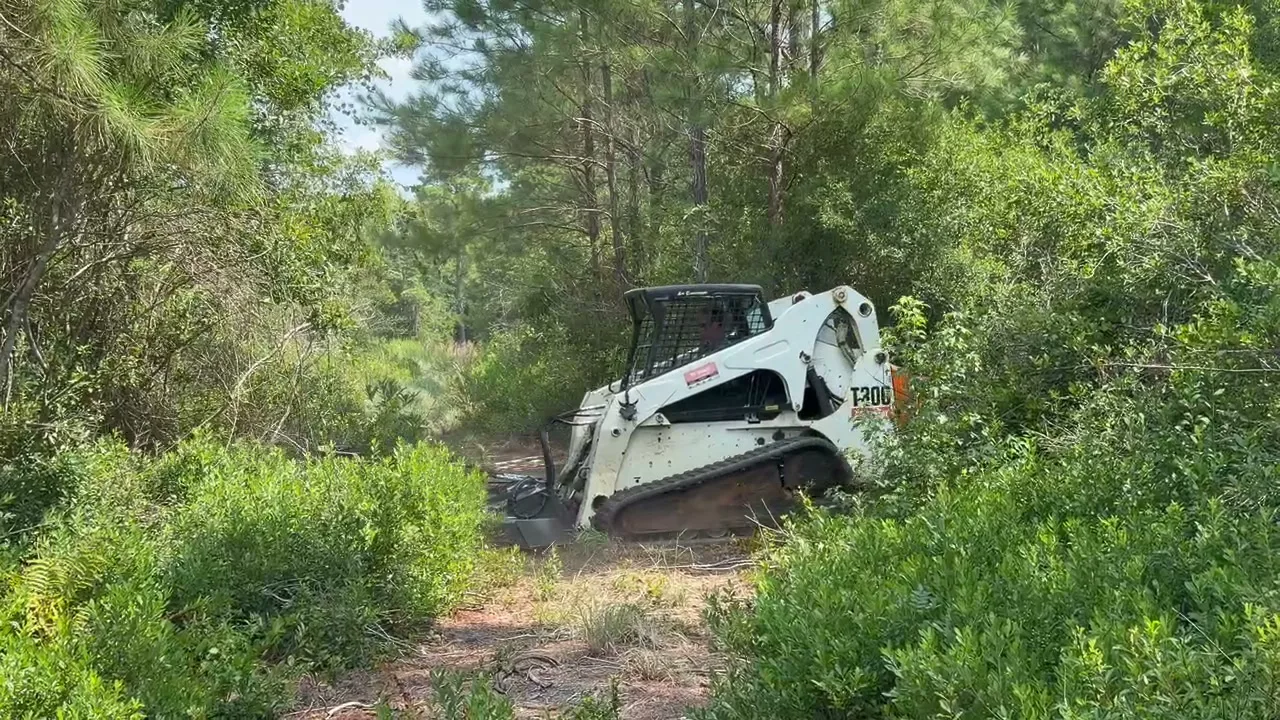
Here is where our machine sits. What the mulcher head does to standing brush and saplings is grind it into chips on the spot. Rubber tracks spread the weight on soft coastal soil, but they still churn saturated ground. So we work the dry uplands of a lot and stop at the flagged line.
What can you do with the wet part of a lot?
More than most owners expect. The wet ground can stay as a buffer or wildlife habitat, and a wood duck hole counts. It holds water in a hard rain, which is worth something on flat land. None of that needs a permit.
Hand work is usually fine. Cutting and mowing above ground is the carve out in the federal rule. The footing has to be firm and the root mat has to stay intact.
If you truly need a crossing or a small fill, ask the Corps first. Nationwide permits are general permits issued by the Corps of Engineers on a nationwide basis. They authorize minor activities with little delay or paperwork. Several of them lost their South Carolina certification in the January 2026 reissuance.
Larger impacts bring mitigation. It offsets unavoidable adverse impacts which remain after all appropriate and practicable avoidance and minimization. Owners buy it through mitigation banks, in-lieu fee programs or permittee-responsible mitigation.
Is it different across the line in North Carolina?
Yes, and the gap widened in 2023. North Carolina used to run a state permit for isolated wetlands. The 2023 NC Farm Act, SL 2023-63, became effective on June 27, 2023 and ended it. NC DEQ now says no permit is required for impacts to an isolated wetland.
The state definition followed the federal one. NC DEQ limits wetlands protected under state water quality rules to those under federal jurisdiction. So an isolated wetland in Brunswick or Columbus County can fall outside both layers.
Two things still apply. An isolated permit is still required for impacts to isolated streams in North Carolina. DWR also recommends securing confirmation of jurisdiction from the Corps first.
When a 401 certification is needed, NC DEQ charges by scale. Minor water quality applications run $341.00 and major ones run $810.00. Brunswick and Columbus counties can layer their own rules on top. Call the county planning office first.
What should you do before the machine shows up?
Work the paper before anyone brings a machine. Four of these five steps are free, and the fifth settles the question. Most owners can knock out the free ones in one afternoon. The order matters, because the map tells the consultant where to look.
- Pull your parcel on the National Wetlands Inventory mapper and save the image.
- Pull the same parcel on Web Soil Survey and note any hydric soils.
- Go look at the low spots after a hard rain, not in August.
- Read the plat and the deed for a wetland line or a buffer note.
- If any of it looks wet, hire a consultant and ask the Corps for a determination.
Keep the paperwork. A Corps verified delineation is good for five years, and SCDES wants one no older than that. Then clear the dry part with a line to work to.
Category 5 Land Management runs a Bobcat T300 with a forestry mulcher head out of Longs, SC. The land clearing we run across Horry and Georgetown counties reaches Brunswick and Columbus counties in North Carolina too. We look at the lot, then tell you which ground we can work and which needs the Corps. Estimates are free and done on site, so set up a free on-site estimate.