What Is Bush Hogging? Cost, How It Works, and When Your Field Needs It
Bush hogging is field mowing with a heavy rotary cutter behind a tractor. The blades chop tall grass and weeds down to a few inches and leave the cuttings on the ground. You need it when a pasture or vacant lot has grown taller than a regular mower can take.
What is bush hogging?
Bush Hog is a brand name for a rotary cutter. The name stuck, so most people now call any heavy field mowing bush hogging. The cutter is a steel deck about 5 to 7 feet wide with thick blades underneath.
Those blades swing on hinges. When one hits a rock or a buried stump, it folds back instead of breaking. That is why a bush hog survives rough ground that would ruin a lawn mower.
A bush hog is built for volume, not looks. It leaves a rough cut around 4 to 8 inches tall with stems and stubble standing. The clippings stay where they fall and break down into the soil.
Most rotary cutters handle grass, weeds, briars, and saplings up to about 1 to 2 inches thick. Past that size, the cutter starts to bog down or bounce over the top.
What does bush hogging cost?
Published cost guides put most field mowing at $50 to $250 per acre. The spread is wide because a kept pasture and an abandoned lot are two different jobs.
SG Land Management, a Georgia land company, publishes a per-acre breakdown by how thick the growth is. Well Built Florida, a Florida cost guide, publishes hourly rates and minimum charges. Here is what both list.
| What the field looks like | Published range | Source |
|---|---|---|
| Kept field, grass under 12 inches | $50 to $75 per acre | SG Land Management |
| Waist high weeds and light brush | $75 to $150 per acre | SG Land Management |
| Chest high growth, saplings under 3 inches | $150 to $250 per acre | SG Land Management |
| Typical job, average conditions | $70 to $120 per acre | Well Built Florida |
| Tractor and cutter, hourly | $75 to $150 per hour | Well Built Florida |
| Minimum charge on a small job | $150 to $350 | Well Built Florida |
Those are other companies’ published numbers, not ours. They are here so you can sanity check any quote you get.
Two things move the price more than acreage does. The first is how long the field sat. The second is what is hiding in it, since old wire and buried stumps both slow a machine down.
Small jobs also carry a minimum. Well Built Florida lists a callout minimum of $150 to $350. Trailering a machine out costs the same for half an acre as it does for five.
Tractor bush hog or tracked mulcher: what does each one handle?
A farm rotary cutter is the right tool for open grass. It moves fast and keeps an already open field from closing in. For that job, nothing beats it on cost.
It has two real limits on the coast. Tractor tires sink in wet sandy ground and cut ruts in the field you were trying to save. Woody stems over about 2 inches also chew up blades and gearboxes.
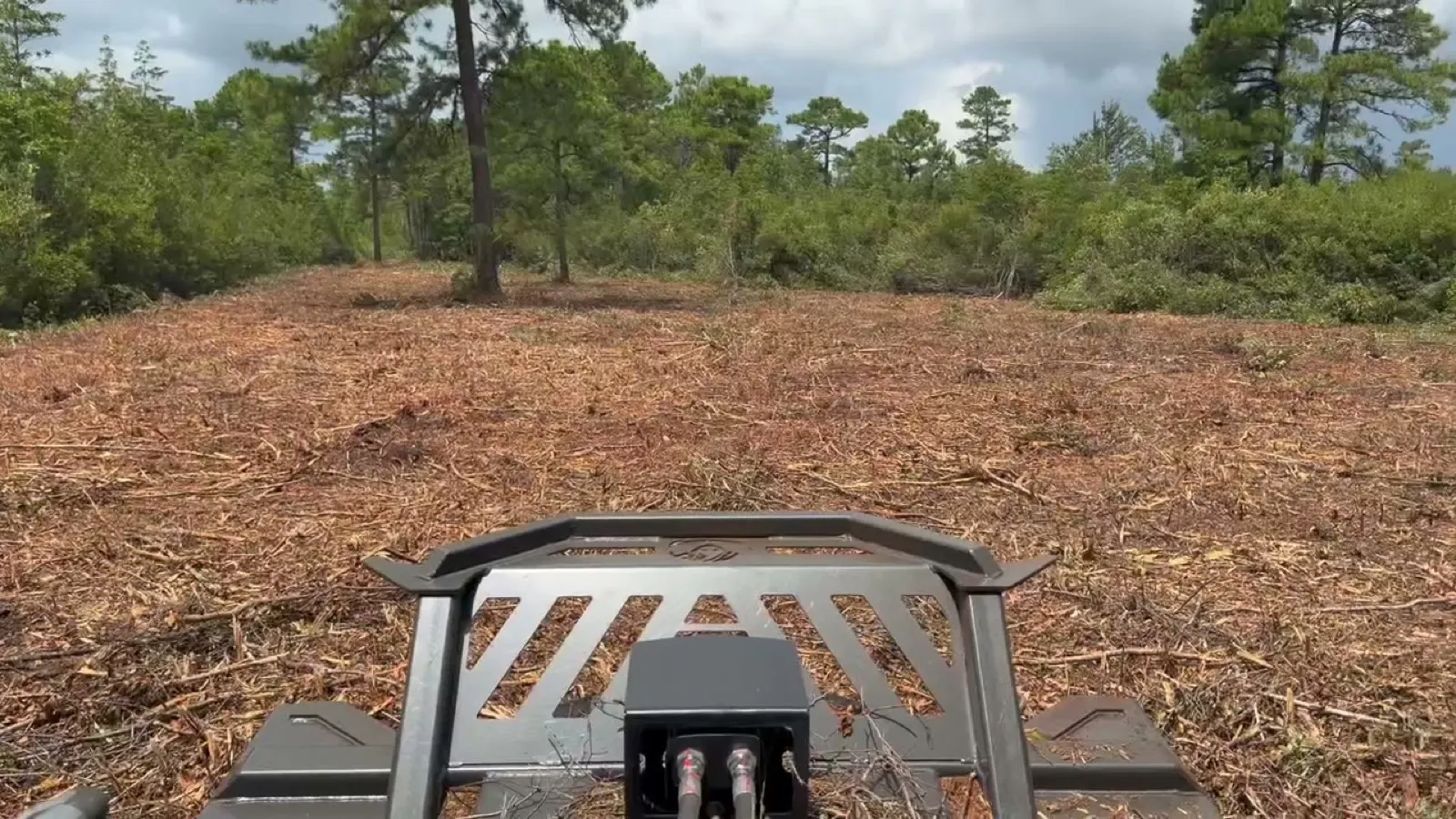
We run a Bobcat T300 compact track loader with a forestry mulcher head. The head grinds material into chips. A rotary cutter only knocks it over.
That head takes woody saplings and thick briar mats a farm bush hog cannot cut. The tracks spread the machine’s weight over a wide footprint. That lets it work soft sandy ground that bogs a tractor.
Everything cut stays on site as mulch, so there is no debris pile left behind. That is what forestry mulching does that mowing does not. It removes the stem rather than the top, so regrowth comes back slower.
How often do coastal South Carolina fields need cutting?
The growing season here is long. Fields around Horry County keep growing from early spring into late fall, and mild winters barely slow the roots down.
A field you want to keep open generally needs two or three cuts across a season. Skip a year and the job changes, because woody plants move in behind the grass.
Those woody plants are the real problem. Sweetgum seedlings come up thick anywhere a field is left alone. Wax myrtle fills in low wet edges and turns into a solid wall fast.
Blackberry and greenbrier make dense mats that hide everything under them. Once those root in, a rotary cutter tends to ride over the top and leave the crowns alive.
When is a field past mowing?
Some signs are obvious. Stems thicker than a broom handle will stall a farm bush hog. Saplings taller than the tractor hood bend and spring back instead of cutting clean.
Other signs are easier to miss. If you cannot see the ground through the briars, a mower cannot see the stumps and holes either. Old fence lines and ditch banks that have grown shut are also past mowing.
At that point the field needs pasture reclamation before any cutting schedule makes sense. A mulcher takes the woody growth down to bare dirt. After that, normal bush hogging can hold the field open.
How do you get a price?
Have a few things ready when you call. Acreage and property location come first. After that, describe how tall the growth is and how thick the stems are.
Photos from your phone help more than a description does. A picture of the worst corner tells us whether it is a mowing job or a mulching job.
We work out of Longs and cover about 50 miles either side of the state line. That takes in Conway, Loris, Aynor, Tabor City, Shallotte, and the rest of the Grand Strand.
One note on scope. We mow and mulch, and the material stays on your ground. We do not grind stumps, take down standing timber, haul material off, or move dirt.
Category 5 Land Management gives free estimates. Call or text (843) 385-1090.